<?xml version="1.0" encoding="utf-8"?><feed xmlns="http://www.w3.org/2005/Atom" ><generator uri="https://jekyllrb.com/" version="3.10.0">Jekyll</generator><link href="https://yihanxu.github.io/feed.xml" rel="self" type="application/atom+xml" /><link href="https://yihanxu.github.io/" rel="alternate" type="text/html" /><updated>2026-09-28T13:51:50+00:00</updated><id>https://yihanxu.github.io/feed.xml</id><title type="html">Yihan|文字园艺</title><subtitle>一枚健康经济学家的生活及思考</subtitle><entry><title type="html">Just show up, no need to overthink</title><link href="https://yihanxu.github.io/just-show-up/" rel="alternate" type="text/html" title="Just show up, no need to overthink" /><published>2026-09-27T00:00:00+00:00</published><updated>2026-09-27T00:00:00+00:00</updated><id>https://yihanxu.github.io/just-show-up</id><content type="html" xml:base="https://yihanxu.github.io/just-show-up/"><![CDATA[<p>At 6:55pm last Friday, standing close to Albemarle Street, I had to make a decision. Should I take the next Tube home, or head to the Royal Institution (RI) as planned to attend physicist <a href="https://www.rigb.org/whats-on/discourse-physics-and-philosophy-equality-all-things">Carlo Rovelli’s discourse</a>?</p>

<p>It was an embarrassing moment. I had invited Leyi to join me for the talk, yet I couldn’t find the tickets! And when I eventually did, I realised that the ticket was for the online stream, not the in-person event, which had already sold out when I booked. Apparently, I had completely forgotten about that!</p>

<p>I decided to go ahead anyway. In my cookbook, there’s always a chance if one shows up. Leyi was reluctant, but agreed to follow suit.</p>

<p>We saw a long queue, joined it, and quickly got our turn. Unsurprisingly, they couldn’t find our names! They checked the guest list and still couldn’t find us. I had to admit that we didn’t actually have the right tickets, even though both of us are RI members.</p>

<p>Surprisingly, we weren’t turned away. Instead, we were directed to reception, where they kindly put our names on the waiting list. Within 10 minutes, we were allowed in!</p>

<p>Once we were seated, I shrugged and told Leyi, “Just show up. That’s my philosophy!”</p>

<p>The simple rule is: you may or may not get in if you show up. But you definitely won’t get in if you don’t.</p>

<p>This rule has been etched in my heart through many, many real-world experiences.</p>

<p>Allow me to be nostalgic again and share a story from my past life.</p>

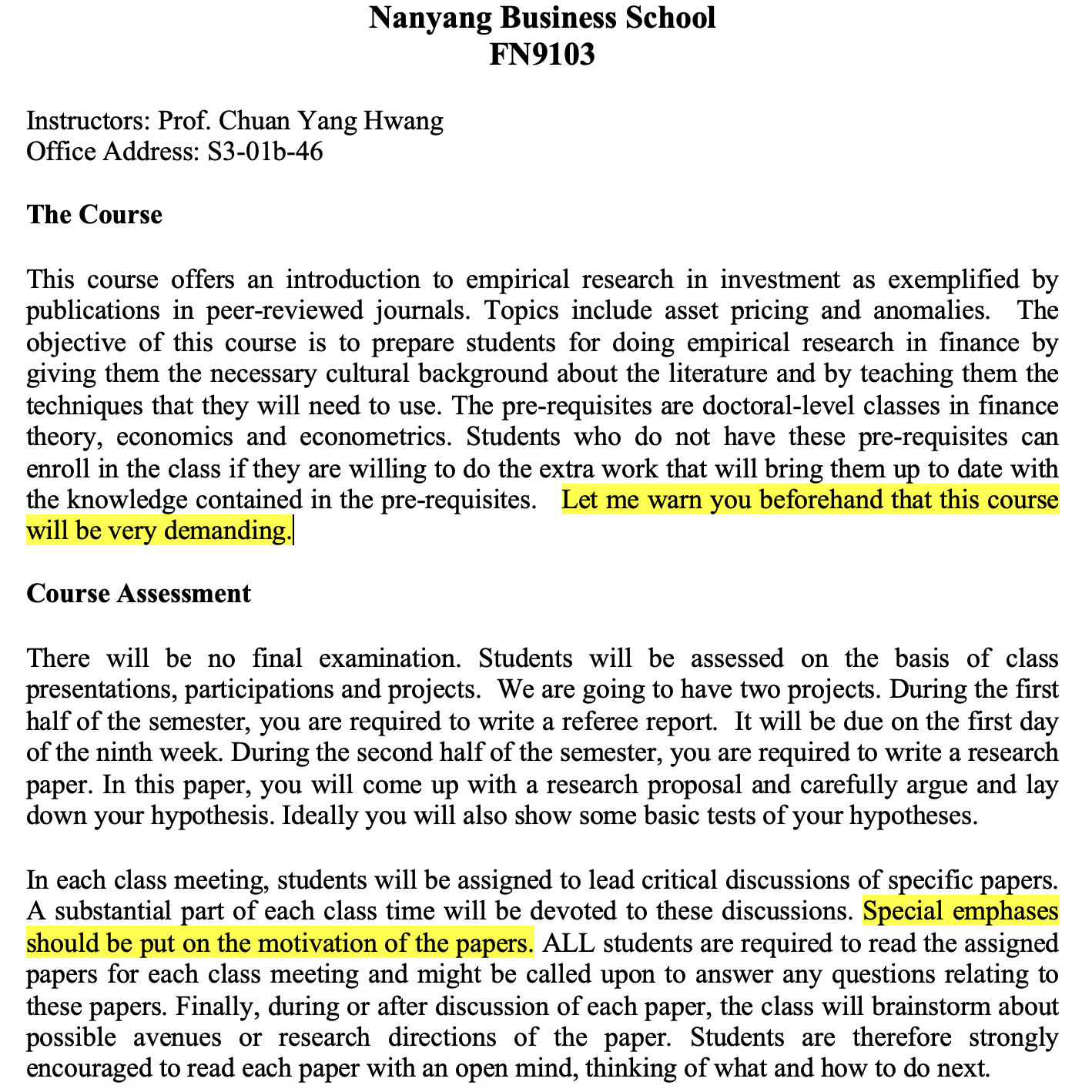
<p>I once took a PhD course from the business school on empirical research in investment.  I was interested because the syllabus included two lectures, out of 13, on behavioural finance, which I thought might be helpful for my thesis in behavioural economics.</p>

<p>I had to write to Prof Hwang to apply, as the course was not offered from my school. He asked for my background and checked which courses I had taken, then rejected my request – I had none of the pre-requisites he specified – doctor-level classes in finance theory, economics, and econometrics.</p>

<p><img src="/images/fn_9103.jpg" alt="course intro" /></p>

<p>I pleaded with him: let me attend the first class, and judge for yourself if I qualify.</p>

<p>He agreed.</p>

<p>His opening lecture was divine, and I still remember him telling us about his wife, who had left her career as a senior accountant, started medical school at 40, and was then practicing in Singapore and was immensely proud of her work.</p>

<p>I was totally captivated and asked tons of questions, trying to demonstrate that I actually knew a thing or two about finance and investment! And apparently I managed to fool him, because he invited me to take the class.</p>

<p>Yet, to my great disappointment, the course was not a seminar at all!</p>

<p>I thought he would be doing lectures weekly, but instead, the five of us were required to present one piece of research every week. The presentation requirements look soft and simple enough, but to explain in your own words why a research question is interesting and what it contributes, you have to be deeply immersed in the literature.</p>

<p>Basically, I was being forced to play professor and teach a subject I knew almost nothing about.</p>

<p>At that point, I was ready to quit. I thought I was good enough to understand Prof Hwang’s lecture, but I definitely was far from good enough to teach! But how could I quit after taking so much trouble to register for it？</p>

<p>So I decided to take it, even if I might fail in the end.</p>

<p>And I did suffer for it. I remember going to bed at 3am before almost every class, which started at 9am, because I had to read so, so much in an unfamiliar field. Typing out the full formulas alone was a huge challenge, let alone telling a coherent story about the research.</p>

<p>But in the end, I did it.</p>

<p>And I got the highest mark.</p>

<p>I’m forever grateful for Prof Hwang for taking the risk of accepting me into the class. He gave me the chance to push myself to my utmost limits. More importantly, the experience made me internalise just how important research motivation is, and helped me develop a taste for identifying what makes a research question genuinely interesting.</p>

<p><a href="https://drive.google.com/file/d/161FItHKug3WsLHsx4d6wrm_sYzdRP2U9/view?usp=drive_link">Here</a> is one of the first presentations I gave.</p>

<p>Thank God I showed up! Showing up is the beginning of all possibilities.</p>

<p>I wrote this story as I wanted to remember this episode of my life, to encourage myself to show up for things that might seem too big, too implausible.</p>]]></content><author><name></name></author><category term="UnquenchableSparks" /><category term="life_advice," /><category term="show_up," /><category term="no_show," /><category term="research_motivation" /><summary type="html"><![CDATA[At 6:55pm last Friday, standing close to Albemarle Street, I had to make a decision. Should I take the next Tube home, or head to the Royal Institution (RI) as planned to attend physicist Carlo Rovelli’s discourse?]]></summary></entry><entry><title type="html">Wear sunscreen? – The advice I memorised at 14</title><link href="https://yihanxu.github.io/wear-sunscreen/" rel="alternate" type="text/html" title="Wear sunscreen? – The advice I memorised at 14" /><published>2026-09-08T00:00:00+00:00</published><updated>2026-09-08T00:00:00+00:00</updated><id>https://yihanxu.github.io/wear-sunscreen</id><content type="html" xml:base="https://yihanxu.github.io/wear-sunscreen/"><![CDATA[<p>Today is the first day back to the office after my holiday. There was very little evidence that I’d had one, except that I’d become one shade darker. One unsuspiciously cloudy day without sunscreen was apparently enough for the sun to leave its mark, very much against my wishes. I don’t like being tanned at all!</p>

<p>I joked with my colleagues that from now on, I should wear sunscreen religiously, even when the sky looks deceptively cloudy.</p>

<p>Suddenly the phrase “wear sunscreen” struck a chord – it was the title for an essay that I memorised at 14.</p>

<p>Back then, I was desperate to learn English, and I loved the rhythm and philosophy of that essay, although I was probably too young to understand much of what I was reciting.</p>

<p>I certainly didn’t follow most of the advice. Much of it simply didn’t seem relevant yet.</p>

<p>Tonight, I read it again.</p>

<p>More than two decades later, I’m still enjoying the rhythm and philosophy, and oddly enough, I may follow more of her advice, not just about the sunscreen.</p>

<p>Have a read, if you haven’t.</p>

<h2 id="wear-sunscreenby-mary-schmich">Wear sunscreen，by Mary Schmich</h2>

<p>If I could offer you only one tip for the future, sunscreen would be it. The long-term benefits of sunscreen have been proved by scientists, whereas the rest of my advice has no basis more reliable than my own meandering experience. I will dispense this advice now.</p>

<p>Enjoy the power and beauty of your youth. Oh, never mind. You will not understand the power and beauty of your youth until they’ve faded. But trust me, in 20 years, you’ll look back at photos of yourself and recall in a way you can’t grasp now how much possibility lay before you and how fabulous you really looked. You are not as fat as you imagine.</p>

<p>Don’t worry about the future. Or worry, but know that worrying is as effective as trying to solve an algebra equation by chewing bubble gum. The real troubles in your life are apt to be things that never crossed your worried mind, the kind that blindside you at 4pm on some idle Tuesday.</p>

<p>Do one thing every day that scares you.</p>

<p>Sing.</p>

<p>Don’t be reckless with other people’s hearts. Don’t put up with people who are reckless with yours.</p>

<p>Floss.</p>

<p>Don’t waste your time on jealousy. Sometimes you’re ahead, sometimes you’re behind. The race is long and, in the end, it’s only with yourself.</p>

<p>Remember compliments you receive. Forget the insults. If you succeed in doing this, tell me how.</p>

<p>Keep your old love letters. Throw away your old bank statements.</p>

<p>Stretch.</p>

<p>Don’t feel guilty if you don’t know what you want to do with your life. The most interesting people I know didn’t know at 22 what they wanted to do with their lives. Some of the most interesting 40-year-olds I know still don’t.</p>

<p>Get plenty of calcium. Be kind to your knees. You’ll miss them when they’re gone.</p>

<p>Maybe you’ll marry, maybe you won’t. Maybe you’ll have children, maybe you won’t. Maybe you’ll divorce at 40, maybe you’ll dance the funky chicken on your 75th wedding anniversary. Whatever you do, don’t congratulate yourself too much, or berate yourself either. Your choices are half chance. So are everybody else’s.</p>

<p>Enjoy your body. Use it every way you can. Don’t be afraid of it or of what other people think of it. It’s the greatest instrument you’ll ever own.</p>

<p>Dance, even if you have nowhere to do it but your living room.</p>

<p>Read the directions, even if you don’t follow them.</p>

<p>Do not read beauty magazines. They will only make you feel ugly.</p>

<p>Get to know your parents. You never know when they’ll be gone for good. Be nice to your siblings. They’re your best link to your past and the people most likely to stick with you in the future.</p>

<p>Understand that friends come and go, but with a precious few you should hold on. Work hard to bridge the gaps in geography and lifestyle, because the older you get, the more you need the people who knew you when you were young.</p>

<p>Live in New York City once, but leave before it makes you hard. Live in Northern California once, but leave before it makes you soft. Travel.</p>

<p>Accept certain inalienable truths: Prices will rise. Politicians will philander. You, too, will get old. And when you do, you’ll fantasize that when you were young, prices were reasonable, politicians were noble and children respected their elders.</p>

<p>Respect your elders.</p>

<p>Don’t expect anyone else to support you. Maybe you have a trust fund. Maybe you’ll have a wealthy spouse. But you never know when either one might run out.</p>

<p>Don’t mess too much with your hair or by the time you’re 40 it will look 85.</p>

<p>Be careful whose advice you buy, but be patient with those who supply it. Advice is a form of nostalgia. Dispensing it is a way of fishing the past from the disposal, wiping it off, painting over the ugly parts and recycling it for more than it’s worth.</p>

<p>But trust me on the sunscreen.</p>]]></content><author><name></name></author><category term="这就是生活" /><category term="life_advice," /><category term="graduation_speech," /><category term="Mary_Schmich" /><summary type="html"><![CDATA[Today is the first day back to the office after my holiday. There was very little evidence that I’d had one, except that I’d become one shade darker. One unsuspiciously cloudy day without sunscreen was apparently enough for the sun to leave its mark, very much against my wishes. I don’t like being tanned at all!]]></summary></entry><entry><title type="html">A product requirement documentation I drafted 8 years ago</title><link href="https://yihanxu.github.io/surreal-editing-experience/" rel="alternate" type="text/html" title="A product requirement documentation I drafted 8 years ago" /><published>2026-09-03T00:00:00+00:00</published><updated>2026-09-03T00:00:00+00:00</updated><id>https://yihanxu.github.io/surreal-editing-experience</id><content type="html" xml:base="https://yihanxu.github.io/surreal-editing-experience/"><![CDATA[<p>I know life is dramatic and unpredictable. But not in my wildest dreams could I have imagined that one day, while sipping cider, with the misty wind from Carbis Bay in Cornwall caressing my hair and face, I’d be helping my former colleague revise a paper that I drafted eight years ago.</p>

<p>As the first author, I was supposed to carry it through and get it published. However, I was soon consumed by my thesis and gave it up.</p>

<p>But the professor who oversaw it apparently didn’t. Not after so many years, and not after it was desk-rejected by a few journals. Last month, we got a minor revision decision, so perhaps it might finally see the light of day? That is, if we address the reviewers’ comments properly and timely.</p>

<p>While reading the reviewers’ report, memories flooded back from the distant past, when I was still in the third year of my PhD. I was keen to design an embodied conversational agent that could gain investors’ trust through thick and thin (as few investors can hold on when experiencing stock market turbulence). It was very much a predecessor of the AI agents we see today. But back then, the agent was far less advanced or fluent. I had to draft all the conversational scripts myself. I also had to draft a tremendous amount of documentation to make the experimental web application I envisioned a reality.</p>

<p>I had almost forgotten all of it until I had to sift through the old files to draft a response to one reviewer’s comment. And then I came across a note I had written to the software engineer to articulate what I wanted.</p>

<p>I was strangely touched by how thorough and dedicated I once was. Some bits of that still live with me, of course, but perhaps they don’t grip me in quite the same way anymore, now that I routinely use AI to help me draft documentation and notes.</p>

<p>I just wanted to share one piece from that era, as a sample of my writing and of the thought that went into it when I was trying very hard to express my requirements clearly.</p>

<h1 id="a-note-on-block-randomisation">A note on block randomisation</h1>

<p>I wrote this note with two goals in mind.</p>

<ul>
  <li>To explain what block randomisation is.</li>
  <li>To illustrate its implications for our experimental design and logistics.</li>
</ul>

<p><em>Last updated:  2 Nov 2018</em></p>

<hr />

<p>We’re all familiar with the idea of randomisation. In our online pilot, we randomly assign participants to different conditions. Except for the conditional variables, we try to hold everything else as the same. We do this to test whether the factors that we’re interested in (e.g. communication style / bot personality) make a difference.</p>

<p>The idea is simple enough, but the implementation is not necessarily so. It’s incredibly hard to <em>isolate</em> and <em>quantify</em> the effects of the experimental factor. You know people used to believe objects fall at speed proportional to their mass. That is, until Galileo used a vacuum chamber to remove the effects of air resistance in his famous Leaning Tower of Pisa experiment. Unfortunately, social science doesn’t have such luxurious, neat tools that physics has, so social scientists have to come up with other ways to build something similar to the vacuum chamber.</p>

<p>Block randomisation could be seen as a “vacuum chamber”, it aims to make the effects of an experimental factor cleaner and more noticeable.</p>

<p>For example, suppose we found that Max was participants’ favourite, but we’re still not sure whether this preference is true for both men and women. What if the following extreme scenario happened?</p>

<table>
  <thead>
    <tr>
      <th> </th>
      <th>Condition 1 (Max)</th>
      <th>Condition 2 (Linus)</th>
    </tr>
  </thead>
  <tbody>
    <tr>
      <td>Participant Pool</td>
      <td>99 men + 1 woman</td>
      <td>99 women + 1 man</td>
    </tr>
    <tr>
      <td>Men’s preference</td>
      <td>8</td>
      <td>6</td>
    </tr>
    <tr>
      <td>Women’s preference</td>
      <td>6</td>
      <td>8</td>
    </tr>
    <tr>
      <td>Preference by condition</td>
      <td>(99x8+6)/100 = 7.98</td>
      <td>(99x6+8)/100 = 6.02</td>
    </tr>
  </tbody>
</table>

<p>If the gender ratio of the participants is skewed, and if the preference differs between men and women, then we may mis-interpret the experimental results. One solution to address the above problem is to divide participants into subgroups called blocks before they visit the lab. For example, we could have men block and women block, each block having the same No. of participants. Then we can randomly assign participants into different conditions within each block – this is the idea of block randomisation. Compared to a completely randomized design, this approach reduces variability (noise) within each condition, giving us a better estimate of the effects caused by condition variables.</p>

<p>Now, for my study 1 lab session, the ideal participant pool will be as follows:</p>

<table>
  <thead>
    <tr>
      <th>Participant Pool</th>
      <th>Condition 1 (Dominant Max)</th>
      <th>Condition 2 (Submissive Linus)</th>
      <th>No. of participants by participantPersonality</th>
    </tr>
  </thead>
  <tbody>
    <tr>
      <td>Participants with dominant personality</td>
      <td>15 men + 15 women</td>
      <td>15 men + 15 women</td>
      <td>60</td>
    </tr>
    <tr>
      <td>Participants with submissive personality</td>
      <td>15 men + 15 women</td>
      <td>15 men + 15 women</td>
      <td>60</td>
    </tr>
    <tr>
      <td>No. of participants by botPersonality</td>
      <td>60</td>
      <td>60</td>
      <td>Total: 120</td>
    </tr>
  </tbody>
</table>

<p>Likewise, for my study 2 lab session, the ideal participant pool will be as follows:</p>

<table>
  <thead>
    <tr>
      <th>Participant Pool</th>
      <th>Condition 1 (Max + Improve)</th>
      <th>Condition 2 (Max + Deteriorate)</th>
      <th>Condition 3 (Linus + Improve)</th>
      <th>Condition 4 (Linus + Deteriorate)</th>
      <th>No. of participants by participantPersonality</th>
    </tr>
  </thead>
  <tbody>
    <tr>
      <td>Participants with dominant personality</td>
      <td>15 men + 15 women</td>
      <td>15 men + 15 women</td>
      <td>15 men + 15 women</td>
      <td>15 men + 15 women</td>
      <td>120</td>
    </tr>
    <tr>
      <td>Participants with submissive personality</td>
      <td>15 men + 15 women</td>
      <td>15 men + 15 women</td>
      <td>15 men + 15 women</td>
      <td>15 men + 15 women</td>
      <td>120</td>
    </tr>
    <tr>
      <td>No. of participants by condition</td>
      <td>60</td>
      <td>60</td>
      <td>60</td>
      <td>60</td>
      <td>Total: 240</td>
    </tr>
  </tbody>
</table>

<p>For the online session, since we couldn’t screen participants based on their gender and personality, we can only rely on luck and wish the participant pool will be similar across conditions. If not, perhaps we could do some ad hoc statistical adjustment, but that’s not good practice.</p>

<p>But for lab session, we don’t want to leave things to chances, we want to take control while we can. That’s why we design the <em>manual configuration</em> mechanism in the beginning. Now as you already know, lab participants take a pre-test questionnaire before visiting the lab. Thus by the time they visit the lab, we  already know their gender and personality type.</p>

<p>My original plan to implement block randomisation is to make a huge spreadsheet of prospective participants, arrange them by date, time slot, gender, and personality. Something like this (for study 1):</p>

<table>
  <thead>
    <tr>
      <th>Date</th>
      <th>Time slot</th>
      <th>Matric Number</th>
      <th>Personality</th>
      <th>Gender</th>
      <th>Condition</th>
    </tr>
  </thead>
  <tbody>
    <tr>
      <td>2018-11-12</td>
      <td>10-11am</td>
      <td>g3423452a</td>
      <td>dominant</td>
      <td>female</td>
      <td>X</td>
    </tr>
    <tr>
      <td>2018-11-12</td>
      <td>10-11am</td>
      <td>g3423233a</td>
      <td>dominant</td>
      <td>male</td>
      <td>X</td>
    </tr>
    <tr>
      <td>2018-11-12</td>
      <td>11-12am</td>
      <td>u3234252b</td>
      <td>submissive</td>
      <td>male</td>
      <td>X</td>
    </tr>
    <tr>
      <td>2018-11-12</td>
      <td>11-12am</td>
      <td>u1452452b</td>
      <td>submissive</td>
      <td>female</td>
      <td>X</td>
    </tr>
    <tr>
      <td>2018-11-12</td>
      <td>13-14pm</td>
      <td>g2423452c</td>
      <td>dominant</td>
      <td>male</td>
      <td>X</td>
    </tr>
    <tr>
      <td>2018-11-12</td>
      <td>13-14pm</td>
      <td>u6423452c</td>
      <td>submissive</td>
      <td>female</td>
      <td>X</td>
    </tr>
  </tbody>
</table>

<p>With this spreadsheet, I’ll just rely on lab assistants to help me balance the proportion of gender and personality. However, now I think I’ll probably get into trouble using this approach. My plan will fail in the following scenarios:</p>

<ul>
  <li>Some participants don’t show up (the non-show-up rate is about 20%), and lab assistants cannot decide quickly how to re-arrange conditions for the missing slots</li>
  <li>A lot of participants with same gender and personality show up together, and lab assistants are simply over-whelmed</li>
  <li>Lab assistants mistakenly assign participants to the wrong conditions</li>
  <li>Lab assistants don’t realise that some conditions have already got 30 participants, thus no need to assign participants to that condition further</li>
  <li>Other unpredictable situations, you name it</li>
</ul>

<p>So what do I want? I need a simple algorithm that implements block randomisation.</p>

<ul>
  <li>Inputs from lab admin: participant gender, personality</li>
  <li>Inputs inferred from experimental design: No. of participant for each cell (30 in my case), No. of conditions, etc.</li>
  <li>Output: The ideal participant pool that I illustrated above</li>
</ul>

<p>Could you think of a way of achieving so? It’ll be great if you could help us with this. The idea of block randomisation will also be applicable for the chat-bot project. Actually, I think it will be useful to a lot of field experiments and commercial projects.</p>

<p><strong>Note:</strong> Integrating this algorithm to the conditionPage may be risky. If you think that’s the case, then just let this algorithm be independent from the current web application. As long as it helps lab admin quickly assign conditions for prospective participants in the unpredictable real world scenarios.</p>

<p>P.S. I know this is doable because I once visited a lab that does block randomisation even for online experiments. The workflow looks like this. It’s a black box for me, hopefully not for you.</p>]]></content><author><name></name></author><category term="SnapshotOfTheDay" /><category term="product_requirement," /><category term="writing," /><category term="PhD_days," /><category term="peer_review," /><category term="cornwall" /><summary type="html"><![CDATA[I know life is dramatic and unpredictable. But not in my wildest dreams could I have imagined that one day, while sipping cider, with the misty wind from Carbis Bay in Cornwall caressing my hair and face, I’d be helping my former colleague revise a paper that I drafted eight years ago.]]></summary></entry><entry><title type="html">My on-and-off weight training</title><link href="https://yihanxu.github.io/my-on-and-off-weight-training/" rel="alternate" type="text/html" title="My on-and-off weight training" /><published>2026-08-23T00:00:00+00:00</published><updated>2026-08-23T00:00:00+00:00</updated><id>https://yihanxu.github.io/my-on-and-off-weight-training</id><content type="html" xml:base="https://yihanxu.github.io/my-on-and-off-weight-training/"><![CDATA[<p>I started weight training about 1.5 years ago. I started as I wanted to gain muscle and be stronger physically, which was not achievable by what I already enjoyed doing (e.g. swimming, yoga).</p>

<p>I had a strong start – training about 3 times per week, but predictably, like all my previous attempts to attend gyms, it soon cooled off (I blame menstruation for killing the momentum). Yet it didn’t die. My desire to become stronger always resurfaces, so I would restart training again. In total, I have attended about 35 sessions since I started.</p>

<p>I thought all I did was in vain as my weight hardly budged at all. That was until I bought a new body scale and discovered that my bone mass had improved from below average to above average. My body fat had also fallen by 4%, and I had gained muscle. Better still, my metabolic age had dropped by three years. I have to say, I hardly felt any different over that period, although the metrics seemed to tell another story.</p>

<p>It suddenly occurred to me that this was perhaps another example of compounding effects. By repeatedly making one small decision to train, I had achieved an effect beyond what I expected.</p>

<p>At my stage of life, perhaps this is one way, or even the only way, to make big changes in life. Why? Let me first define what I mean by a midlife crisis.</p>

<p>I define the midlife crisis as the unfulfilled state of living on by the force of inertia, after having made most of the big, largely irreversible decisions in one’s life – where to study, what subject to major, which career to choose, whom to marry, whether and when to have children, where to live, and when to buy a house.</p>

<p>I made most of the big bets of my life over the last 15 years, and they dramatically and permanently changed my life trajectory. It’s hard to imagine what my life would look like had I not decided to go to Barcelona to study public health, a very impulsive decision after reading Sanmao’s books. Or had I not decided to go back to the ivory tower for a PhD, again rather impulsively, quitting my job one day and starting to prepare the application documents the next. Or had I not messaged Xinxing after LinkedIn notified me about her new job, which led to a hiking meet-up at Box Hill, where I met Leyi, my future husband.</p>

<p>Now, the decisions I’m left with are mostly trivial and largely reversible. If I buy the wrong size or style of clothes, I can return them for free within 30 days. If I pick fruit that turns out to be less tasty than expected, I can simply buy something else next time. I can pause Spotify and switch tracks at any moment; I can pick up and put down books in a bookshop without committing to any of them. Even when I teach Daniel something wrong, I can overwrite the lesson within a few days.</p>

<p>But not all small decisions are equally small. Some disappear the moment they’re made. What I have for lunch today hardly matters tomorrow. Others accumulate. One weight-training session is trivial; thirty-five apparently aren’t.</p>

<p>Perhaps midlife crisis happens when we run out not only of major decisions, but of the sense that our decisions can still substantially change our future. When I was younger, life changed through a handful of big bets. Perhaps now it changes through making a few small decisions for hundreds of times.</p>

<p>Being stronger is just one of them. I have quite a few others. But before getting to them, let me book tomorrow’s training session first!</p>]]></content><author><name></name></author><category term="SnapshotOfTheDay" /><category term="weigt_training" /><category term="decisin_making" /><category term="midlife_crisis" /><summary type="html"><![CDATA[I started weight training about 1.5 years ago. I started as I wanted to gain muscle and be stronger physically, which was not achievable by what I already enjoyed doing (e.g. swimming, yoga).]]></summary></entry><entry><title type="html">My struggle with languages</title><link href="https://yihanxu.github.io/struggles-with-languages/" rel="alternate" type="text/html" title="My struggle with languages" /><published>2026-08-15T00:00:00+00:00</published><updated>2026-08-15T00:00:00+00:00</updated><id>https://yihanxu.github.io/struggles-with-languages</id><content type="html" xml:base="https://yihanxu.github.io/struggles-with-languages/"><![CDATA[<p>If you’re one of my regular readers, you’d notice that I’ve almost stopped blogging for some years. Beneath the mundane excuses – that I’ve become busier being a mum and a researcher, there is a more fundamental reason. That is my struggle with languages.</p>

<p>In theory, I’m supposed to be more expressive as I speak multiple languages. In practice, I’m not able to fully express myself in either. For years, I lived on a “English for work, Chinese for life” model. This is a typical model for many immigrants who leave their home country as an adult.</p>

<p>I simply lack the English vocabulary to describe iridescent colours, intricate smells, delicate touches, or name names. Many idioms/slangs remain totally foreign to me. I also cannot hum along with melodies that could move peers to tears. I probably also don’t get 50%+ of the jokes when the British evoke cultural lexicons that I didn’t grow up with.</p>

<p>Yet I’m perfectly fine with talking about philosophies, writing eloquent propositions, and I probably know the Bible better than most people who used to attend Sunday schools. Those are precisely what would make me stutter in Chinese.</p>

<p>So if I want to talk about work and life at the same time with a sufficiently good fidelity and sensitivity, it’s more difficult than I’d like to admit.</p>

<p>My workaround, in previous years, was to reserve English for work and social, and to blog predominantly in Chinese, on my observations in life. Yet after spending more than a decade aboard, my Chinese has become duller and rustier –I can feel I’m losing grip of the mastery. I felt this particularly strongly When I reread what I wrote years ago – I definitely can’t write like that any more. In other words, my Chinese linguistic muscles have shrunk, my productive vocabulary has decayed into receptive one. I can’t write my life with ease and grace in Chinese now.</p>

<p>My second workaround, which I started last year, was to write on LinkedIn. Because it’s a platform for professional networking, so presumably I could write about professional topics using my working language. During this grand writing experiment, I did find myself more comfortable and fluent writing not only about work, but also occasionally about life. But there’s a catch.</p>

<p>I don’t think the audience there is someone I genuinely want to write for. It’s no longer people you’re weakly connected with, but more likely to be a dynamic cohort generated by the algorithm, depending on the topics and hashtags. And writing for a random cohort means you have to earn the trust and attention every time, from scratch.</p>

<p>Posts without a catchy title, strong opening, or a selfie are rarely pushed, noticed, let alone read.  Even when it’s read, the experience is seldom accumulative. Except for very few people, I couldn’t expect any pre-requisite, so each post has to be very self-contained, almost memory-less. This form of writing is hardly satisfying – most of the times, I prefer to talk to old friends who remember something about me than to a new acquittance where I have to start with the weather.</p>

<p>So I’ve exhausted my workarounds. I realise that if I still care to express my worldview, observations, and feelings, I need to overcome my struggle with languages, the sooner the better.</p>

<p>So I decided to try to write about my life in English. It may or may not work, but I guess it’s better than inaction. Perhaps one day Daniel will be glad about the decision I made today, to take a glimpse of my life at a time when he had no memory of.</p>

<p>P.S. I’ve left this post completely unedited by AI, as I want to preserve a writing sample for comparison, to see if I will eventually become more expressive in my working language.</p>]]></content><author><name></name></author><category term="SnapshotOfTheDay" /><category term="culture" /><category term="writing" /><category term="languages" /><summary type="html"><![CDATA[If you’re one of my regular readers, you’d notice that I’ve almost stopped blogging for some years. Beneath the mundane excuses – that I’ve become busier being a mum and a researcher, there is a more fundamental reason. That is my struggle with languages.]]></summary></entry><entry><title type="html">A speculation on the origin of face the music</title><link href="https://yihanxu.github.io/speculation-on-music/" rel="alternate" type="text/html" title="A speculation on the origin of face the music" /><published>2026-08-09T00:00:00+00:00</published><updated>2026-08-09T00:00:00+00:00</updated><id>https://yihanxu.github.io/speculation-on-music</id><content type="html" xml:base="https://yihanxu.github.io/speculation-on-music/"><![CDATA[<p>I learnt the phrase “face the music“ more than two decades ago, and I’ve always wondered why on earth would music connote something ominous. Why music, of all things?</p>

<p>Music is heavenly.</p>

<p>The dictionaries offer a few hypotheses, but I found none of them satisfactory. One theory suggests that it’s used to characterise how a conductor feels when he has to go on stage and perform, subject himself to the judgment of the crowd. Another suggests that it describes the experience of disgraced soldiers when they are publicly dismissed or “drummed out” while military music played.</p>

<p>Recently, I came across an alternative hypothesis that is far more pleasing.</p>

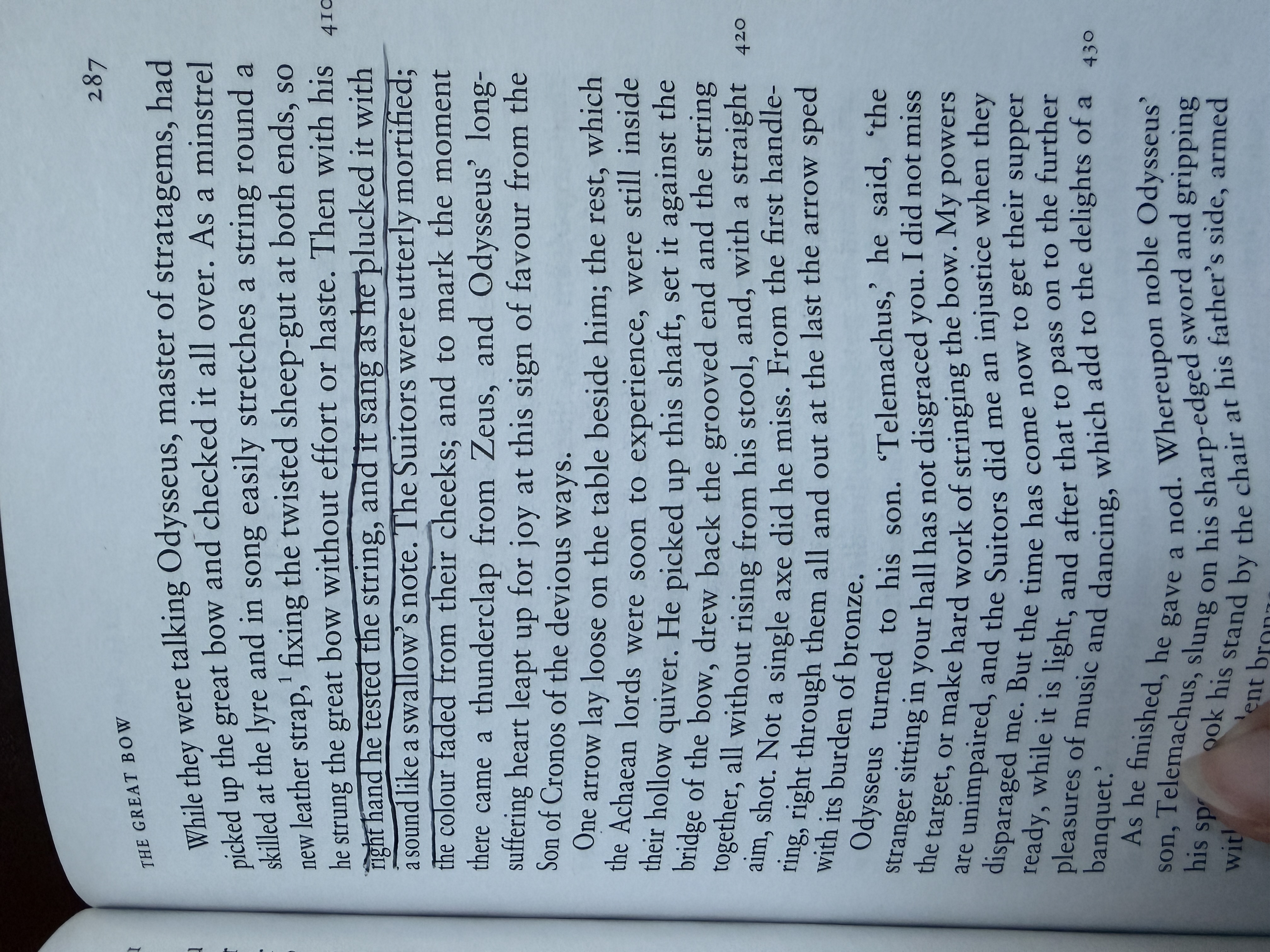
<p>After watching Nolan’s Odyssey, the image of Odysseus strung his great bow stuck with me. I decided to relive that image by rereading the book on the great bow. And there it says:</p>

<blockquote>
  <p>Odysseus strung the great bow without effort or haste. Then with his right hand he tested the string, and it sang…</p>
</blockquote>

<p><img src="/images/odysseus_great_bow.jpg" alt="Odysseus' great bow" /></p>

<p>What music could sound more mortifying than the note that flows from Odysseus’ great bow?</p>

<p>And there the Suitors faced the music (or the divine justice), and paid the ultimate price for their 20 years of insolence.</p>

<p>I have no evidence whatsoever that this is where the phrase came from, but I find it rather elegant.</p>]]></content><author><name></name></author><category term="SnapshotOfTheDay" /><category term="culture" /><category term="Odysseus" /><category term="music" /><category term="semiotics" /><summary type="html"><![CDATA[I learnt the phrase “face the music“ more than two decades ago, and I’ve always wondered why on earth would music connote something ominous. Why music, of all things?]]></summary></entry><entry><title type="html">简单总结下2025年</title><link href="https://yihanxu.github.io/bye-2025/" rel="alternate" type="text/html" title="简单总结下2025年" /><published>2025-12-31T00:00:00+00:00</published><updated>2025-12-31T00:00:00+00:00</updated><id>https://yihanxu.github.io/bye-2025</id><content type="html" xml:base="https://yihanxu.github.io/bye-2025/"><![CDATA[<p>从平安夜开始头痛发烧，躺了6天，终于在2025年的最后一天回了点血，让我有能量回顾一下过去的这一年的高光与低光时刻。</p>

<ol>
  <li>
    <p>半只脚重回学术圈。想当年博士毕业的时候立志这辈子再也不要给论文排版调格式了，但命运就是这么喜欢跟你开玩笑。好在如今写论文的体验愉悦了很多。因为读博期间练就忍受痛苦与延迟满足的能力已经成为了我人格的一部分，加上做咨询多年练就的项目管理能力，让我不再偏执于完美，而是更在意完成。一作发表两篇，在审两篇；非一作发表两篇，在审两篇，虽然比不上学界同僚，但感觉已经足够雪耻了。</p>
  </li>
  <li>
    <p>升了个职。虽然入职不久老板就承诺说会给我在一年内申请升职，但真正兑现承诺还是让我很欣喜。我之前很担心的母职惩罚居然没有发生，实在是要感谢我爸妈的担待以及老张的支持，不然我一己之力肯定是无法兼顾的。感恩！</p>
  </li>
  <li>
    <p>爸妈8月底回国后，我跟老张就开启了育儿的hard模式。感觉育儿的苦懂的自然懂——娃无法言说需求的痛苦，瞬息万变的心情，飞流直下的眼泪鼻涕水，惊天动地的哭声，40度的高烧，半夜12点换的屎尿布，吐湿的床单，飘忽不定的作息，无法预测的胃口。。。那种失控感压得人胸痛，尤其是自己也被娃传染生病的时候。没错，即便大牛笑容如天使，声音绵柔如软糖，踩着雨靴帅得一塌糊涂，我也无法忘却育儿之痛（老张的耐受度显然比我高很多）。</p>
  </li>
  <li>
    <p>找了三个供应商设计了新厨房，不过由于效率低下，心心念念的厨房还没安装上，只能明年再说了。</p>
  </li>
  <li>
    <p>Fei给我们设计了我心心念念想要的新花园！之前给我们老家设计的花园给我们带来了很多快乐，可惜我们只享受了两年半就搬走了。希望这次设计的花园我们能多享受几年。希望可以找到理想的施工团队实现我的心愿！</p>
  </li>
  <li>
    <p>大牛从4月开始上幼儿园小小班，现在居然已经是班上算是最独立的娃了，明年一月就要上小班了，时间真快！在我们眼力，他这一年学会了好多大本事——爬来爬去、跌跌撞撞、小步快跑、叽叽喳喳说话。虽说这些在发展心理学家眼力都只是是稀松平常事，但我们还是很为他高兴，觉得成就感满满。</p>
  </li>
  <li>
    <p>开始学习风险投资并且尝试投资了一些，过几年来验证一下我的商业直觉。</p>
  </li>
  <li>
    <p>继续定期弹琴学琴，虽然并没有很大长进，但每次乐音响起，我感觉都能短暂逃离一下熵高的现实世界。我妈兴许是受了我影响，也搞了电钢琴准备学琴了。榜样的力量很强大啊哈哈！我爸的Duolingo学习也没有懈怠，他期待以后能跟外孙用英语对答如流呢！</p>
  </li>
  <li>
    <p>教会生活稳定，定期读经，定期参加活动，一起祷告，彼此扶持。希望新一年可以更深入地认识新老朋友，并且可以让自己不惧怕分享自己的vulnerable时刻。</p>
  </li>
  <li>
    <p>结婚9周年啦。虽然有娃以后跟老张意见不和的点多了一些，但我们的能耐能力也得到了相应的锻炼。希望明年可以好好庆祝一下十周年！</p>
  </li>
</ol>

<p>2025年就总结到这里。2026，欢迎你的到来！</p>]]></content><author><name></name></author><category term="这就是生活" /><category term="年终总结" /><category term="new_year" /><summary type="html"><![CDATA[从平安夜开始头痛发烧，躺了6天，终于在2025年的最后一天回了点血，让我有能量回顾一下过去的这一年的高光与低光时刻。]]></summary></entry><entry><title type="html">当妈十月吐个槽</title><link href="https://yihanxu.github.io/Daniel-10-months-old/" rel="alternate" type="text/html" title="当妈十月吐个槽" /><published>2025-02-22T00:00:00+00:00</published><updated>2025-02-22T00:00:00+00:00</updated><id>https://yihanxu.github.io/Daniel-10-months-old</id><content type="html" xml:base="https://yihanxu.github.io/Daniel-10-months-old/"><![CDATA[<p>今天是特殊的一天。大牛虽然还没到生日，但他在娘胎外待的时间（293天）已经超过娘胎内（291天）啦！这也就意味着，对我而言，怀孕似乎也是很久以前的事了呢。由于我不太想回想起自己圆滚滚的样子，所以孕期没怎么记录心境，现在想想颇有遗憾。所以趁记忆还新鲜，还是稍微记录下当妈后生活发生的变化吧。</p>

<h2 id="1-生活变热闹了同时也变孤独了">1. 生活变热闹了，同时也变孤独了</h2>
<p>爸妈在时经常感叹我有娃有狗，家里可真热闹。他们没说的潜台词是：哭声、吠声、瓢盆声，声声入耳；抱娃、溜狗、收残局，事事操心。生活的确比以前热闹了，但嘈杂的背后，却藏着另一种孤独。</p>

<p>这种孤独，源于我的育儿经历不在主流叙事里，很难找到真正的共鸣。</p>

<p>身边的妈妈们，大多经历的是两种典型模式：要么是老公产假短，自己独自扛起育儿重任，撑起半边天，产假休一年，甚至从全职转为兼职，全身心投入带娃；要么是超级职业女强人，生完一两个月就全职回归职场，所向披靡，干脆请全职保姆或奶妈看娃。而我，却恰好卡在这两种模式的夹缝里——娃五个月大时全职回归，父母公婆都有不同程度的协助，公婆走后恰逢老张有几个月花园假可以在家带娃，而且娃也刚好能去幼儿园了。</p>

<p>这样的育儿模式，无论是在中国还是在英国，都不太符合常见的育儿叙事。于是，每当聊起育儿话题，别人往往习惯性地按既定框架来安慰我：“妈妈独自带娃太辛苦了！我们一起约遛娃吧！” 可我早就回去上班了，听了只觉得无从附和，更无法赴约；或者他们开始大倒苦水，抱怨丧偶式育娃，可老张在家认真带娃，我也没法加入这场“吐槽老公大赛”；要么，就是羡慕地说：“你有爸妈帮忙，太幸运了！” 但再怎么幸运生活方式也是发生了不小的变化。</p>

<p>跟有娃的朋友聊，我没有独自一人带娃的“战斗感”，没有全职带娃的“全情投入感”，也没有缺席育儿的“职场女强人感”。但跟没娃的同事聊，又是隔靴搔痒。于是，我的经历变得难以被归类，也变得难以叙述，当然也就难以找到共鸣。</p>

<h2 id="2-婴儿阶段颇有点乏善可陈">2. 婴儿阶段颇有点乏善可陈</h2>
<p>很多人说，孩子的每一天都在变化，育儿是充满惊喜的旅程。我感觉说这话的人可能是延时摄影看多了。把过去的生活点滴缩成一个短视频肯定是让人感动的，但置身其中的大部分时间还是颇有点乏善可陈。</p>

<p>现阶段娃的需求层次虽然有限，但他表达方式有限，行动力有限，可预测性也有限。所以为了搞懂他的需求，我不得不读了一堆育儿书，企图用理论指导实践。书的确是有用的，但效用远远比不上菜谱——菜谱上的步骤可以照做，能复现味道；而育儿书的理论看似科学，实操时却总有偏差，就像拿着“公式”解一道变量无数的应用题，现实远比书上写的更复杂。更何况，育儿书本身读起来并不有趣，妥妥说明书，还是读文史哲艺术科学带劲儿。</p>

<h2 id="3-转机是否就在不远处">3. 转机是否就在不远处？</h2>
<p>即便现阶段有点乏善可陈，但这是否预示着将来会有转机？常言道：Things will get a lot worse before it gets better. 装修，收拾屋，
转行——几乎所有好事在发生前，都会经历一段混乱无序的阵痛期。也许婴儿阶段的单调和琐碎只是铺垫，等他再长大一点，能走能说、能思考能互动，育儿的体验会迎来一个新的层次——不再是单方面的照料，而是双向的交流；不再只是日复一日的喂养和哄睡，而是能真正参与他的探索和成长。</p>

<p>不知道是不是太天真啦，总是toddler阶段马上就要来啦，惊喜与惊吓都一起期待一下吧！</p>]]></content><author><name></name></author><category term="这就是生活" /><category term="育儿碎碎念" /><category term="新生活" /><category term="大牛" /><summary type="html"><![CDATA[今天是特殊的一天。大牛虽然还没到生日，但他在娘胎外待的时间（293天）已经超过娘胎内（291天）啦！这也就意味着，对我而言，怀孕似乎也是很久以前的事了呢。由于我不太想回想起自己圆滚滚的样子，所以孕期没怎么记录心境，现在想想颇有遗憾。所以趁记忆还新鲜，还是稍微记录下当妈后生活发生的变化吧。]]></summary></entry><entry><title type="html">简单总结下2024年</title><link href="https://yihanxu.github.io/bye-2024/" rel="alternate" type="text/html" title="简单总结下2024年" /><published>2024-12-31T00:00:00+00:00</published><updated>2024-12-31T00:00:00+00:00</updated><id>https://yihanxu.github.io/bye-2024</id><content type="html" xml:base="https://yihanxu.github.io/bye-2024/"><![CDATA[<p>以前写年终总结总喜欢长篇大论，细数心路历程。然后前几年感觉心力匮乏，就没写，错过了反思人生的好机会。今年发生了这么多变化，再不写有点说不过去，就多少说几句吧。</p>

<ol>
  <li>
    <p>开始练车，并报考路考数次，本想在生娃前拿到英国驾照，可是都失败了。这给了逢考必过、战无不败的我一个重大打击。但没办法呀，不知道是伦敦路考难还是孕期反应慢，总之25年还得接着考呀。</p>
  </li>
  <li>
    <p>当上了高龄产妇。孕期坚持锻炼一直到41周。本想顺产，但预产期12天后还是没生，就决定剖腹产。剖腹产后体验了一周的残疾人生，但不想憋家里坐月子，于是对伦敦社区、商场、博物馆里的无障碍通道的用户体验有了一手经验。</p>
  </li>
  <li>
    <p>给儿起了名，英文为Daniel，中文名为大牛。希望他像旧约里的但以理先知一样，成为一名有影响力的移民，在某个领域当个大牛。当然，当不成也没事儿，强壮如牛也行，但可千万别犟。</p>
  </li>
  <li>
    <p>跟爸妈公婆共处超过三个月，关系没崩。爸妈终于肯出国看<del>我</del>外孙了，他们在伦敦住了小半年，收获了无数跟外孙互动的时光。老爸重拾英文，从5月开始加入多邻国，年末成为排名前3%的好学生。老妈开始少油少盐饮食，瘦身不少，所有之前的衣服都能穿了，重获自信。公婆来后也成功瘦身，俩人加起来一个半月内瘦了17kg，还在继续减重中。</p>
  </li>
  <li>
    <p>今年虽然没回国，但很幸运的见了几个自远方来的老友。志婷冬天来，怡昕夏天来，思杰与鸿泽秋天来，他们见证了我的新身份，也见证了大牛从小丑娃到小可爱的蜕变，希望来年有更多朋友可以再来相聚。</p>
  </li>
  <li>
    <p>告别老牌国企NHS，产假结束前加入创业公司，开始关注女性健康。同事都是博士，合作起来颇有默契。很开心可以告别繁文缛节，进入节奏更快结果导向的工作环境。同时开启<a href="https://yihanxu.substack.com">英文博客</a>，虽然产量堪忧，但至少是一个新开始。</p>
  </li>
  <li>
    <p>写完了硕士论文。论文提案死线是三月，只比我预产期早一个月，本来都写了邮件想申请宽限些时日，结果被告知只能延期到明年。于是本着分不在高及格就行的原则勉强提交了提案，没想到得到了嘉奖。然后系里给我分配了导师，两周聊一次，迫于定期汇报的压力，完成了本以为无法完成的论文。</p>
  </li>
  <li>
    <p>读完了健康经济学硕士，成功毕业。八门课加一篇论文，也算拿了个distinction吧，没给博士丢脸哈。</p>
  </li>
  <li>
    <p>加入教会小组 home group，认识了有娃的新朋友。感觉博士毕业参加工作后人生变得越来越独立，几乎不再需要父母的支持，生活中也很少有求于朋友或邻居。为人父母后重新把人打回原形了，我又再度需要依赖别人，不仅依赖父母公婆的支持，还要依赖朋友的建议。</p>
  </li>
  <li>
    <p>开始学钢琴。主因是古典吉他练习遇到瓶颈，需要从乐理上突破，次因是孕期肚子大，不好练吉他，于是开始跟着Simply Piano自学，从叮叮当弹到了love story。虽然技艺一般，但成功引起隔壁娃的注意，给他施加了练琴的隔辈压力。</p>
  </li>
  <li>
    <p>保持了日常读经的习惯，但没有系统性地重读圣经。读经方面没有懈怠，但也没有打鸡血读很多。看了不少电影与杂书，但大多只图一时放松，不求甚解，颇有点遗憾。希望这点可以在明年弥补一下。</p>
  </li>
  <li>
    <p>开始给自己的中年人生做规划，跟老张以季度为单位反思总结自己的成长与倒退。目前还不想制定跟parenting相关的目标，因为现阶段我想尽可能的多鸡我们自己，少鸡娃。</p>
  </li>
</ol>

<p>一不小心就超过了十条，还是先写到这里吧。年终总结，明年见！</p>]]></content><author><name></name></author><category term="这就是生活" /><category term="年终总结" /><category term="new_year" /><summary type="html"><![CDATA[以前写年终总结总喜欢长篇大论，细数心路历程。然后前几年感觉心力匮乏，就没写，错过了反思人生的好机会。今年发生了这么多变化，再不写有点说不过去，就多少说几句吧。]]></summary></entry><entry><title type="html">Ode to small talk in the British way — From reluctance to appreciation: a journey through British small talk</title><link href="https://yihanxu.github.io/ode-to-small-talk/" rel="alternate" type="text/html" title="Ode to small talk in the British way — From reluctance to appreciation: a journey through British small talk" /><published>2024-10-05T00:00:00+00:00</published><updated>2024-10-05T00:00:00+00:00</updated><id>https://yihanxu.github.io/ode%20to%20small%20talk</id><content type="html" xml:base="https://yihanxu.github.io/ode-to-small-talk/"><![CDATA[<p>As a Chinese Londoner who has spent more than five years in this marvelous city, I’ve grown fond of one British institution: small talk. My initiation into this ritual was not so smooth. When I started my first job after my PhD in London, I faced a cultural shock. The company was extremely welcoming—I received more than a dozen coffee chat invites from colleagues in my first week. I was overjoyed, yet unease crept in. What on earth would I say? Should I talk about my research, the weather, or maybe what I had for breakfast?</p>

<p>Fast forward five years, and I’ve unknowingly embraced the necessity of small talk. It was only when I joined my new company during maternity leave and noticed the absence of the British small talk ritual among some colleagues that I realized how it had become second nature to me.</p>

<p>I took the “no ask, no tell” approach in interviews, keeping my situation private. But it was small talk during team dinner — a colleague innocently asked if I managed to get any break before starting — that allowed me to reveal my new-mother status in a natural way. It wasn’t an abrupt announcement; it was a natural segue. And to my surprise, the revelation open doors. My colleagues reciprocated, sharing their stories and making me feel heard and connected.</p>

<p>It struck me then how this seemingly trivial ritual is the backbone of British social interaction. It builds a foundation that allows deeper, more meaningful conversations to flourish.</p>

<p>Of course, not all small talk is entertaining. At times, I felt like an outsider when conversations involved topics I knew nothing about (e.g. cricket!) or when insider jargon flew around. For a while, I longed to bypass the chit-chat and jump straight into business. However, having experienced the alternative, I’ve come to realize that small talk is an acquired taste—much like durian or coffee. It’s not exactly appealing the first time, but after a few tries, it gets more tolerable, and can become surprisingly enjoyable in the end!</p>

<p>So here’s to small talk, the British way – the ritual that once puzzled me, then warmed me, and ultimately eased my way into new conversations.</p>]]></content><author><name></name></author><category term="SnapshotOfTheDay" /><category term="culture" /><category term="small" /><category term="talk" /><category term="british" /><summary type="html"><![CDATA[As a Chinese Londoner who has spent more than five years in this marvelous city, I’ve grown fond of one British institution: small talk. My initiation into this ritual was not so smooth. When I started my first job after my PhD in London, I faced a cultural shock. The company was extremely welcoming—I received more than a dozen coffee chat invites from colleagues in my first week. I was overjoyed, yet unease crept in. What on earth would I say? Should I talk about my research, the weather, or maybe what I had for breakfast?]]></summary></entry></feed>